
How to Teach Your Child to Write Their Name (Without Frustration)
By Leslie Dykstra · Certified Early Childhood Specialist · Williamson County, TN
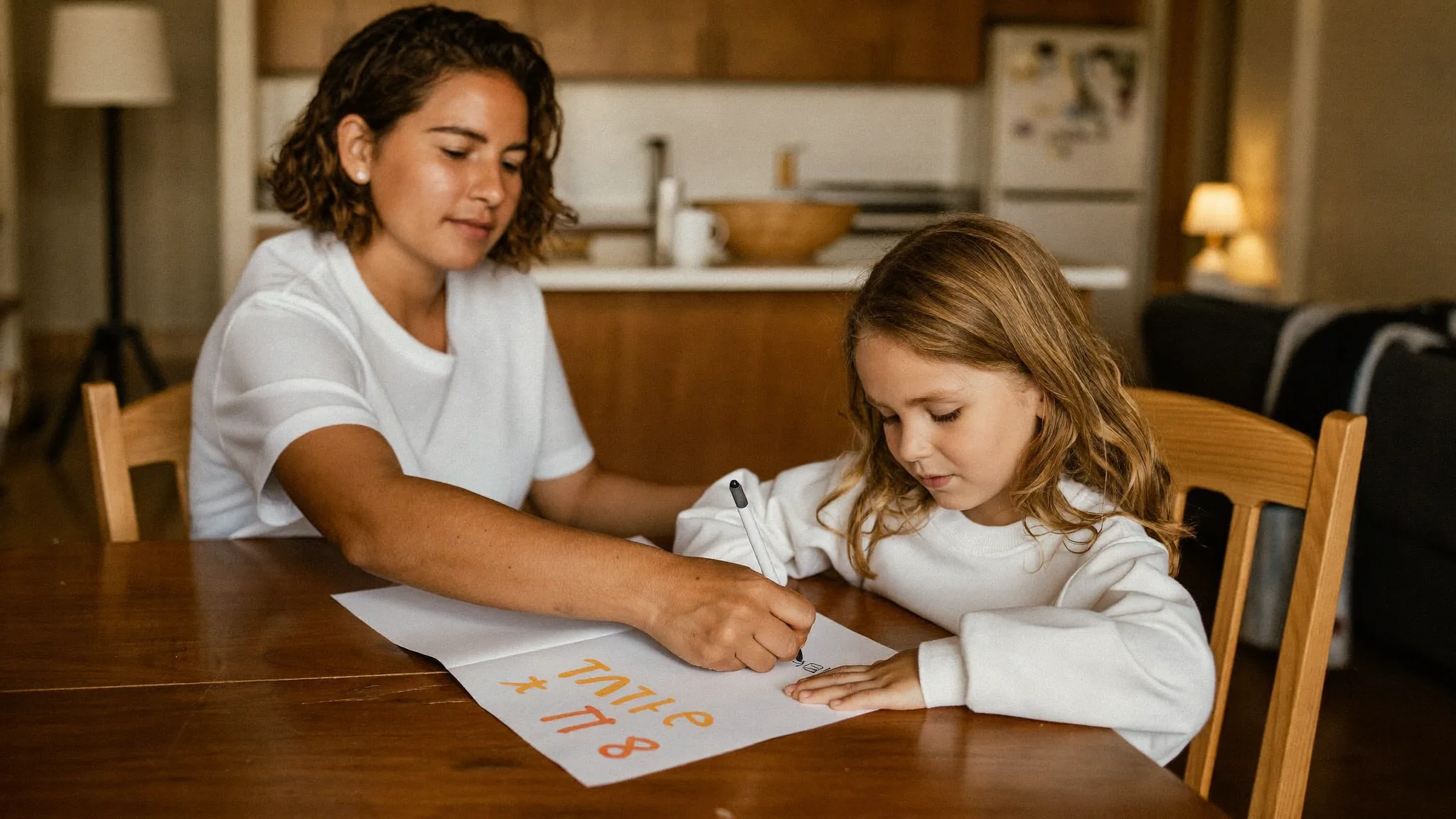
Writing their name is often a child's first real writing goal. It matters to them. It connects to identity and school readiness in a way that writing random letters doesn't. That's what makes it worth doing thoughtfully — and what makes the frustration hurt a little more when it shows up.
As a certified early childhood specialist working with families across Nolensville and Williamson County, I've helped many children learn to write their name. The approach that works is slower and more playful than most parents expect. Here's what I'd tell you if we sat down together.
When should a child learn to write their name?
Most children are developmentally ready to write their first name with some consistency between ages 4 and 5. Some children get there earlier, some later. The range is wide and normal.
Before handwriting happens on paper, children need enough fine-motor strength and control to hold a pencil with a comfortable grip. If your child is younger than four, or if pencil grip is still wobbly, the activities below will build those skills while keeping things fun.
If your child is already in kindergarten and struggling with name writing specifically, don't panic. Many children arrive at school still working on this, and teachers expect it. A few weeks of intentional practice at home can make a real difference.
What fine-motor skills does name writing require?
Writing letters takes more muscle control than it looks like. Your child needs:
- A functional pencil grip (ideally three fingers: thumb, index, and middle)
- The ability to control small movements with their wrist and fingers
- Enough hand strength to press with a pencil without cramping
- Visual tracking — watching what their hand is doing as they form letters
If any of these areas are still developing, pencil-and-paper practice will feel harder than it needs to. The good news is that everyday play builds all of these. Playdough, threading beads, tearing paper, using scissors, picking up small objects — all of it strengthens the same small muscles that handwriting uses.
How do I actually teach it, step by step?
Work through these stages. Stay at each stage until it feels comfortable before moving on.
Stage 1: Big, full-body movements. Before fingers, use the whole arm. Let your child trace the letters of their name in sand, shaving cream, or with a large paintbrush on the sidewalk. This builds the letter shapes in memory without the grip demands of a pencil.
Stage 2: Vertical surfaces. Writing on a wall, a window with window markers, or a whiteboard at eye level builds shoulder and forearm strength that transfers to desk writing. It also changes the wrist angle in a way that makes letter formation easier.
Stage 3: Dot-to-dot or highlight tracing. Write your child's name in large, clear letters. Have them trace it — either following dots, or going over your lines with a highlighter. Keep letters big, at least an inch tall. Tracing builds the motor path before independent forming.
Stage 4: Copy below yours. Write the name at the top of the page. Your child writes it underneath, looking up at yours. This is different from copying from a page across the table — the model should be close and easy to reference.
Stage 5: Independent writing with prompts. Write the first letter only and let them fill in the rest from memory. Then write nothing at all and see what they can do. Celebrate whatever comes — even a wobbly version of the first letter.
How long should practice sessions be?
Short. Very short. For preschool-age children, two to three minutes of focused writing is enough. Pushing longer invites frustration.
A daily habit of very short practice outperforms once-a-week long sessions every time. You can build it into something you're already doing — name on an artwork, name on a letter to grandma, name on a birthday card.
The goal is for name writing to feel normal and casual, not like a task they have to get through.
What if my child gets frustrated or refuses?
Back up a stage. Frustration usually means the current demand is a bit ahead of their readiness. That's useful information.
A few things that help:
- Use their preferred medium. If pencils feel hard, try chalk, crayons, dry-erase markers on a laminated card, or their finger in a tray of sand.
- Make it purposeful. "Write your name on your drawing so we know it's yours" lands differently than "practice writing."
- Keep your voice calm. A child who feels watched and evaluated tightens up. Breezy and matter-of-fact is the tone you want.
- Drop it for the day and try again tomorrow. A child who is done is done. Coming back fresh is usually more productive than pushing through.
If you've tried these approaches and name writing continues to feel very hard, it may be worth looking at fine-motor skills more carefully. A personalized assessment can tell you where things stand and what to target next.
You can also take a look at the Kindergarten Readiness Checklist to see how name writing fits into the broader picture of kindergarten skills. And if your child is heading into kindergarten soon, the programs we offer include handwriting support alongside early literacy and math.
Frequently asked questions
Should my child write their name in all capitals or mixed case?
For a child's first name, use a capital first letter and lowercase for the rest — the way it will appear in school. All-capitals is sometimes easier at the very beginning, but it can create habits that need to be unlearned. Start with proper case when possible.
My child writes their name as a mirror image. Is that a concern?
Letter and name reversals are completely normal before age 7. A child who writes their name backward or reverses individual letters is doing something that most children do. It generally resolves with practice and time. If it persists past second grade, it's worth mentioning to a specialist.
Can I teach name writing in a week?
The physical skill builds over weeks, not days. What can happen in a week is noticeably less effort — letters that look more like letters, less frustration, more willingness to try. Consistent daily practice moves things faster than anything else.
Want help building your child's writing and fine-motor skills?
Book a free 15-minute conversation to talk through where your child is and what would help. We love this stage — there's so much that can shift quickly with the right approach.
Little Minds, Big Futures — where every child's potential takes flight.