5 Ways to Interact With Your Child to Build Critical Thinking at an Early Age
By Leslie Dykstra · Certified Early Childhood Specialist · Williamson County, TN
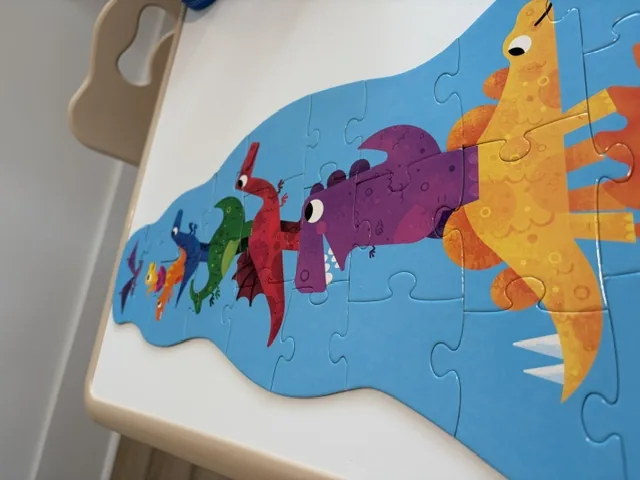
We know that doing puzzles at a very early age is wonderful for little ones. Puzzles build spatial awareness, they teach cause and effect, and all that pinching and turning strengthens the finger grip your child will one day need to hold a pencil.
But here is the question I love: while your child is building that puzzle, how do we grow their critical thinking at the same time? The answer is simpler than it sounds. You sit down beside them, and you ask good questions.
1. Ask about the colors
Start with the easiest entry point there is: "What colors do you see in this puzzle?"
If your child isn't able to name all the colors yet, modify the question rather than skipping it. Ask where the colors are instead: "Where do you see the red dinosaur?" "Can you show me the purple one?" "Which one is your favorite?"
This is a lovely, no-pressure way to see how many colors your child truly recognizes — and asking "which is your favorite?" almost always gets a why out of them, which is where the real thinking lives.
2. Count the things inside the picture
Don't stop at counting the pieces (although "how many puzzle pieces are there?" is a great one). Count what's in the picture: "How many eyeballs do you see?" "How many dinosaurs are showing their teeth?" "How many have wings?"
When your child touches each item as they say a number, they are practicing one-to-one correspondence — matching one number word to one object. That is the skill underneath real counting, and it matters far more than being able to rattle off "1-2-3-4-5" from memory. I explain the difference here: counting vs. actually understanding numbers.
3. Ask where things are
Now ask about location. "Which dinosaur is the highest? Which one is the lowest?" "What is in the middle?" "Which one is closest to the corner?"
Questions like these hand your child positional words — top, bottom, above, below, next to, between — and positional language is one of the four foundations of early math. It also happens to be exactly the vocabulary a kindergarten teacher uses all day long when giving directions.
4. Ask about size and position together
Next, compare. "Where is the smallest one?" "Which is the biggest dinosaur on this page?" "Which dinosaur is on top of the purple one?" "Which one is under the green dino?"
Comparing (biggest, smallest, longer, shorter) and positional words are both early math skills, and stacking them into one question makes your child hold two ideas at once — which is precisely what critical thinking is. Keep using those positional words out loud until they become familiar, everyday language. There are more everyday ways to practice in my post on foundational math concepts for ages 1–5.
5. Ask them to invent the next piece
This is my favorite one, and it's the biggest thinking stretch of them all: "If you drew another part of this puzzle, what would you design to add onto it?"
Suddenly there is no right answer to find — your child has to imagine something that doesn't exist yet, describe it, and explain why it belongs. That is creativity, reasoning, and language all in one question. And if you have a crayon and a scrap of paper nearby, let them actually draw it. You will be amazed at what comes out.
Why open-ended questions matter so much
Notice that not one of those five questions can be answered with "yes" or "no." That is the whole trick. A closed question ends a conversation; an open-ended question asks a child to explain their thinking, and explaining is where vocabulary, reasoning, and confidence grow.
A few small things that make this work even better:
- Wait longer than feels comfortable. Little brains need a few extra seconds. Count silently to five before you jump in.
- Ask "why?" or "how do you know?" after their answer. That second question is where the thinking really happens.
- Say it back with a few more words. "Purple!" becomes "Yes — the big purple dinosaur on top!"
- Follow their interest. If they want to talk about dinosaur teeth for ten minutes, talk about dinosaur teeth. Engagement is the whole point.
- Keep it short and happy. Two or three good questions during one puzzle is plenty. This should feel like play, never a quiz.
Parents are their child's number one "toy"
Engaging with children at this age is so beneficial for setting them up for early academic success. And remember — parents are their number one toy. The puzzle is wonderful, but the puzzle plus you is where the learning multiplies, because you are the only one in the room who can respond, wonder out loud, and ask the next question. I wrote more about that here: your child's favorite toy isn't a toy — it's you.
This is exactly the way I teach children: keeping them engaged by asking open-ended, critical thinking questions the whole way through. Consider this a little glimpse of how to think like an educator — and you can absolutely do it at your kitchen table tonight.
Frequently asked questions
What age should my child start doing puzzles?
Earlier than most parents expect. Chunky knob puzzles work well around 12–18 months, simple 4–6 piece puzzles around age 2, and 12–24 piece puzzles by ages 3–4. Match the puzzle to where your child is rather than to the age printed on the box — a puzzle that's slightly too easy still gives you plenty to talk about. (More favorites in my list of the best educational toys for ages 3–8.)
What if my child can't answer my question?
Modify the question instead of dropping it. If they can't name a color yet, ask them to point: "Show me the red dinosaur." If counting to ten isn't there yet, count together and touch each object as you say the number. The goal is to keep them thinking, not to get a right answer on the first try.
Should I help my child finish the puzzle?
Help with the frustration, not with the piece. Narrow the search rather than solving it — "Let's look for a piece with a bit of purple on it" or "Try turning that one around." Children build persistence when they get to be the one who finally makes the piece click. If frustration is a regular visitor at your house, here's how to help a frustrated learner.
What are open-ended questions, exactly?
Questions that can't be answered with yes or no. "Do you like this puzzle?" ends the conversation. "Which dinosaur is your favorite, and why?" opens it up. Open-ended questions ask a child to explain their thinking, which grows vocabulary, reasoning, and confidence all at once.
Want to see your child thrive?
If you'd like to talk about where your child is and what would help them most, book a free 15-minute consultation with Leslie. Little Minds, Big Futures — where every child's potential takes flight.